
Management report details increases in sanctuaries, public fishing areas, and aquaculture
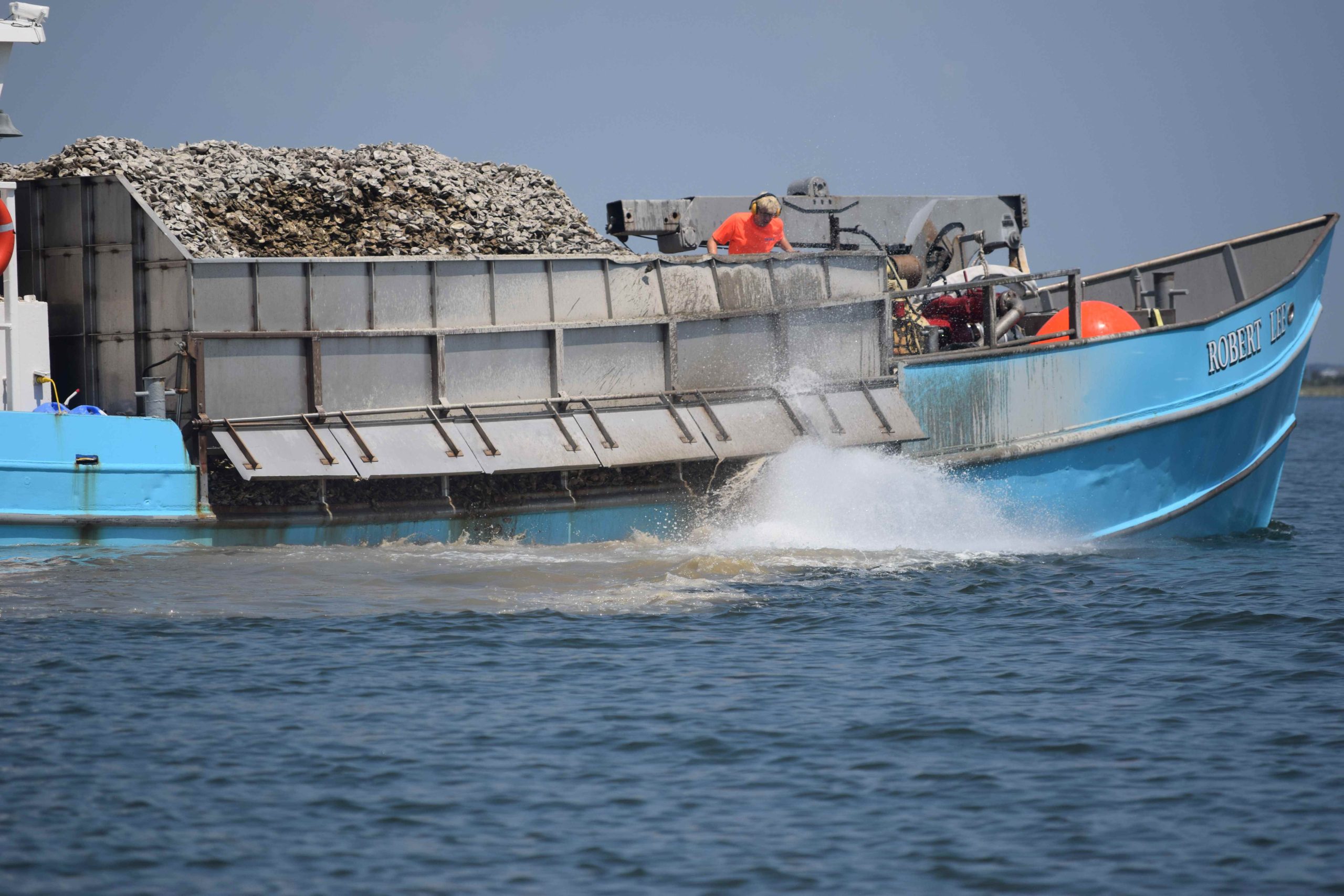
Oyster shells are planted at the Manokin River sanctuary as part of the work to restore five large-scale oyster sanctuaries, a major goal of the Chesapeake Bay Watershed Agreement. Photo by Joe Zimmermann/Maryland DNR
A new Maryland Department of Natural Resources report details the significant growth of the oyster population and substantial progress toward the state’s oyster management goals for the past five years.
The report is part of the department’s commitment to assess the three areas of oyster management—sanctuaries, public fishery areas, and aquaculture—every five years.
On Friday, the department released the 2021-2025 Oyster Management Review, which found that the state has met or made positive progress toward its objectives in all three areas.
The review looks back on a highly productive five-year period, which saw the highest averages for Maryland oyster reproduction, habitat availability, and overall biomass in decades, as well as low levels of disease and observed mortality.
Aside from describing positive outcomes for areas of public fishery and aquaculture, the review analyzes the considerable success seen in the state’s oyster sanctuaries, including 33 sanctuaries that are either restored, trending positively, or undergoing restoration, compared to only four areas that are not performing better since being designated as a sanctuary.
“These past five years underscore the remarkable success story for oysters in Maryland,” Department of Natural Resources Secretary Josh Kurtz said. “We’ve seen really impressive population growth in our oyster sanctuaries and in public harvest areas. At the same time, oyster aquaculture continues to expand throughout the state. These wins are vital for the health of the Chesapeake Bay and to the economic prosperity of Maryland communities.”
Success in sanctuaries
DNR set five objectives for sanctuary areas in 2019; the review found that the state has met two objectives and the other three are in progress.
One met objective was the department’s 2025 completion of initial restoration of five large-scale tributary sanctuaries, aligning with the state’s 2014 Chesapeake Bay Watershed Agreement commitment. The other met objective is conserving and protecting oyster habitat and biomass through continued maintenance.
The state is also seeing progress on increasing oyster populations, broodstock (mature oysters that can produce future generations), and oyster biomass (the total weight of oysters in the ecosystem). Most sanctuary areas showed positive trends in increasing oyster density, and effective restoration techniques have allowed for steady increases in biomass. DNR is continuing to support small-scale and community-based restoration in tributaries throughout the Chesapeake Bay.
The review also describes the state’s 51 oyster sanctuaries based on their performance and restoration status as of 2025. Aside from the five restored sanctuaries, 12 sanctuaries have positive population growth or average densities exceeding 94.2 oysters per square meter on fall survey sampled sites, and another 16 sanctuaries have received or have plans for restoration or plantings.
Four sanctuaries are underperforming and under evaluation for corrective action. The remaining sanctuaries are either set for educational, nonprofit, or laboratory research (five sanctuaries) or lack data because of an inability to sample or have minimal historical habitat (nine sanctuaries).

Oysters are a keystone species in the Chesapeake Bay because they form reefs, creating habitat that fosters an ecosystem, and because they are important for filtering water. Many of the ecological benefits of oysters are most prominent when the shellfish are able to form dense, three-dimensional reefs, which provide habitat for fish and other aquatic life.
Because sanctuaries are permanently closed to harvest, except on aquaculture lease sites, these areas are intended as places where oysters can grow undisturbed. Scientists also hope these sanctuaries will increase the Bay’s overall spawning stock of oysters and facilitate natural disease resistance.
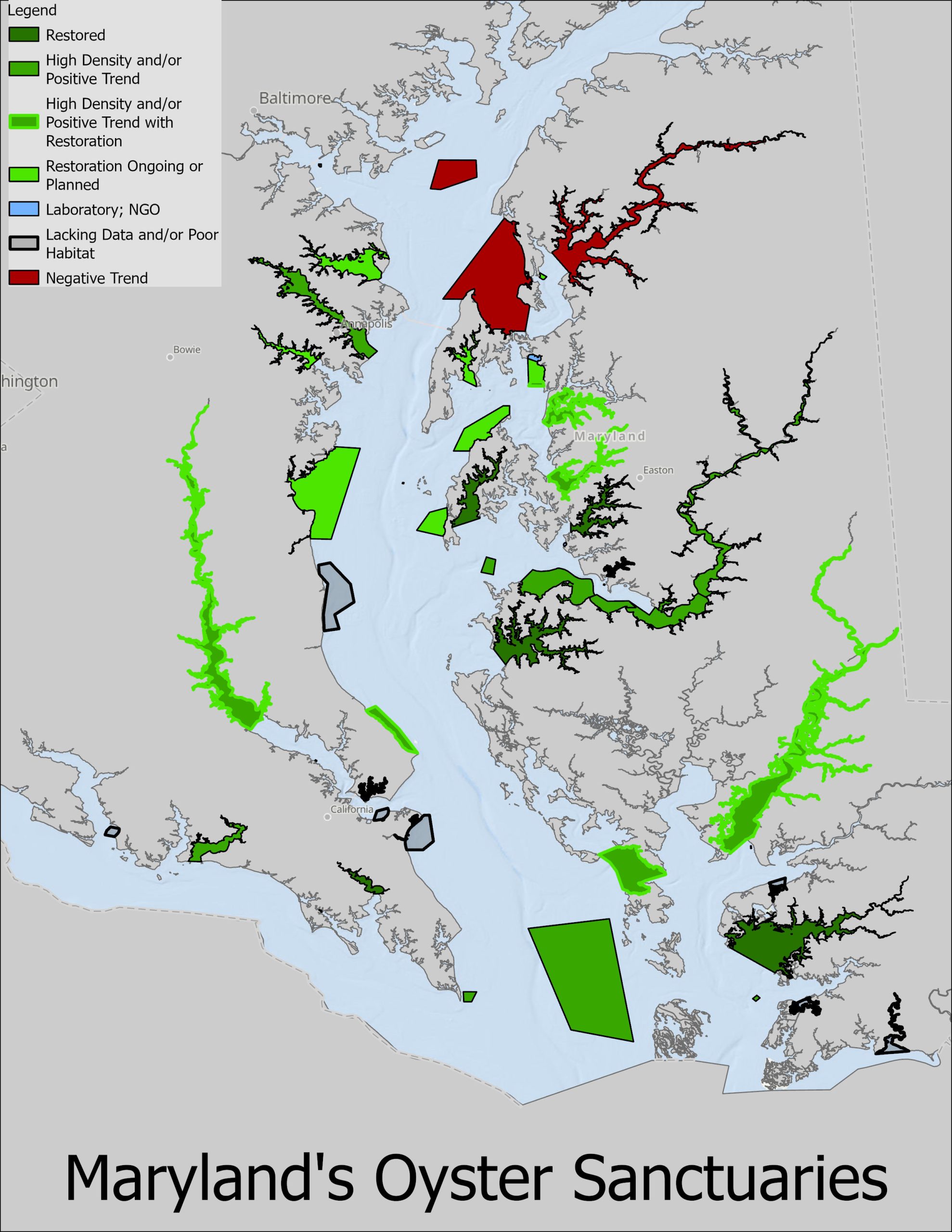
The report reviewed different sanctuary areas based on a number of metrics, including the number of adult oysters (small and market size), the amount of spat (or juvenile oysters), the available habitat, and the observed level of mortality. This data was used to determine a ranking score that compared how sanctuaries were doing relative to other sanctuaries. The top performing sanctuaries included the St. Marys River, Little Choptank River, Nanticoke River, Harris Creek, Upper Choptank River, Hoopers Strait, and Tred Avon River.
Data used to determine the characteristics and long-term trends in the sanctuaries comes from DNR’s annual Fall Oyster Survey.
The 2021-2025 Review’s Appendix A includes detailed information about each of the state’s 51 sanctuaries, including tables of sampling data and graphs of trends over time. The full report and appendices are published on DNR’s website. Learn more about the sanctuaries through a detailed Storymap on Maryland’s oyster sanctuaries or an interactive map of the sanctuaries.
Growth in public fishery areas
The oyster population growth in sanctuary areas was concurrent with an upward trend in many non-sanctuary areas. In the five years that the review assessed, a majority of non-sanctuary areas experienced significant increases in total live oyster density, market-sized oysters, and biomass.
Of the department’s three 2019 objectives for oyster public harvest areas, one is being met and two are ongoing. DNR is meeting the objective of overseeing the fishery with science-based management that is based on biological stock assessments. This effort includes the 2024 stock assessment that found oyster populations in Maryland waters had more than tripled from 2005 to 2023.
The state is also achieving a sustainable public oyster fishery with increasing oyster density and biomass, as well as favorable recruitment rates and low mortality in many areas. DNR is managing the oyster fishery by setting harvest limits and carrying out hatchery produced spat-on-shell plantings, shell plantings, wild seed plantings, and substrate construction to enhance the stock of oysters.
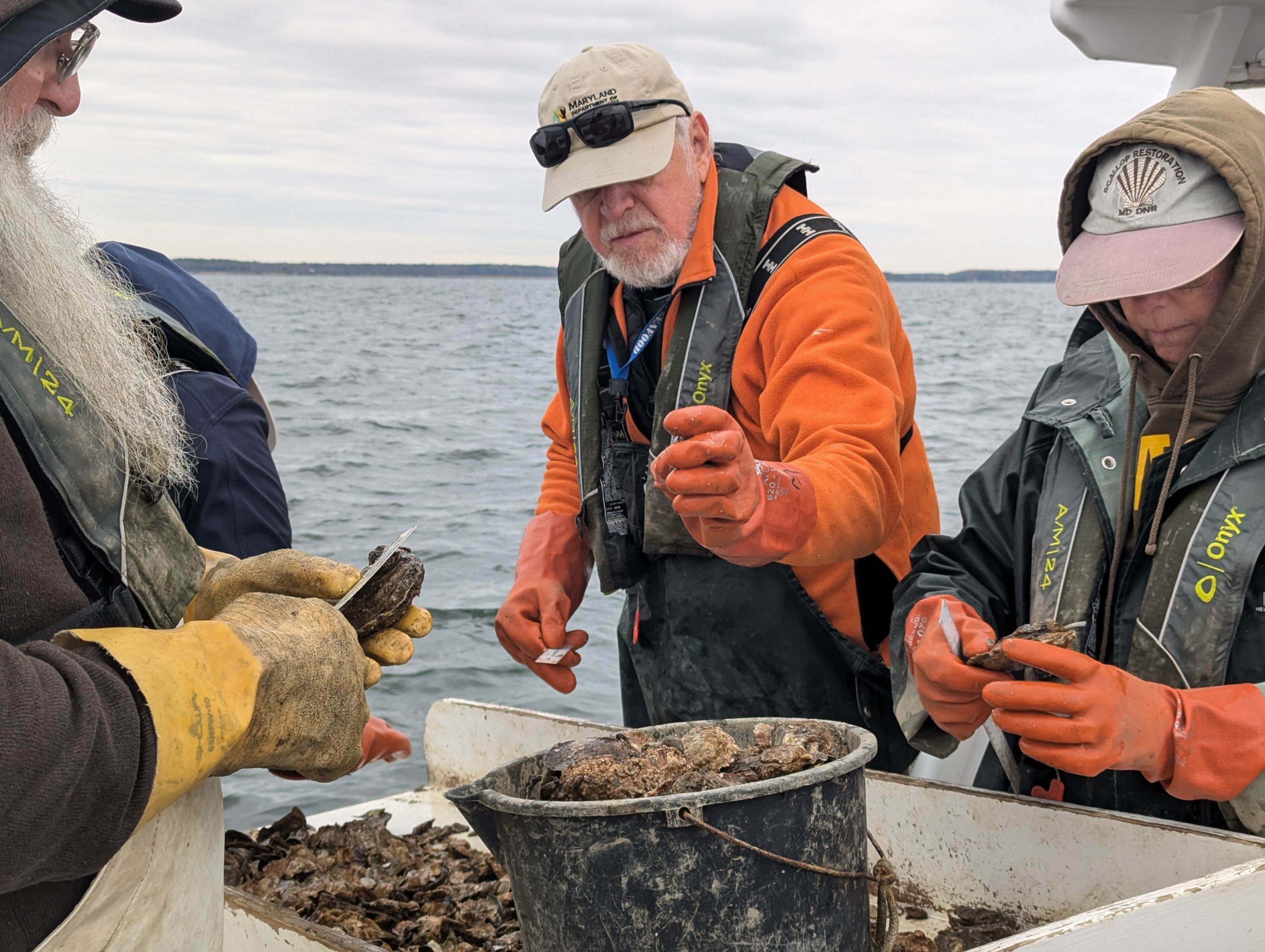
Maryland biologists, including Mitch Tarnowski (center), who leads the survey, count the spat, or juvenile oysters, in samples of dredged material as part of the annual fall oyster survey. Photo by Joe Zimmermann/DNR
The review also assessed the productivity of oysters in harvest areas. A majority of non-sanctuary areas in 2021-2025 saw significant increases in total oyster density, market-sized oysters, and biomass compared to earlier five-year periods. Mortality also remained below long-term averages, although several higher salinity areas experienced more mortality due to oyster diseases in 2023.
The public oyster fishery experienced strong harvests during the years of the review, with harvests in 2021-2022 and 2022-2023 seasons being the highest in decades and generating more than $21 million and $31 million in dockside value respectively. Despite hardships faced by watermen last winter due to market conditions and freezing weather, available data suggests that large amounts of oysters are present in fishery areas to sustain future harvests.
Similar to the review of the sanctuary areas, the review analyzed the density of oysters, observed mortality, and habitat in public harvest areas. The department then compared and ranked these public harvest areas. Broad Creek, Tred Avon River, Upper Patuxent River, Smith Creek, Middle Choptank River, and Wicomico River East ranked as the top harvest areas sampled in Maryland, while the low-salinity area in the Lower Chester River experienced low recruitment that resulted in some local harvest closures.
The review’s Appendix B has a detailed breakdown of observed oyster metrics at public harvest areas across Maryland waters of the Chesapeake Bay and its tributaries. The full report and appendices will be published on DNR’s website.
Aquaculture expansion
DNR is making progress toward its two aquaculture objectives: supporting policies and partnerships that increase private investment in oyster aquaculture, and expanding oyster aquaculture in areas with suitable habitat.
The state has evaluated and improved the permitting process for oyster aquaculture, and a partner loan program allows aquaculture leaseholders to purchase equipment, shell, and seed. In partnership with the University of Maryland and Maryland Sea Grant, the department also developed aquaculture training and education programs. The department is exploring a demonstration lease program that would allow schools and other organizations to educate people on the ecological and economic benefits of oysters.
DNR has also created an online mapping tool, the Aquaculture Siting tool, to help prospective commercial shellfish lease applicants locate potential lease areas.
Maryland modernized its aquaculture leasing program in 2010, requiring leaseholders to actively cultivate their leases, and DNR has received 649 shellfish lease applications between that time and 2025. There are now 471 active leases in the state, spanning 7,622 acres. Harvest from aquaculture leases has grown from 22,428 bushels in 2013 to 94,286 in 2023, and the industry is estimated to have an economic impact of more than $13 million annually in the state.
